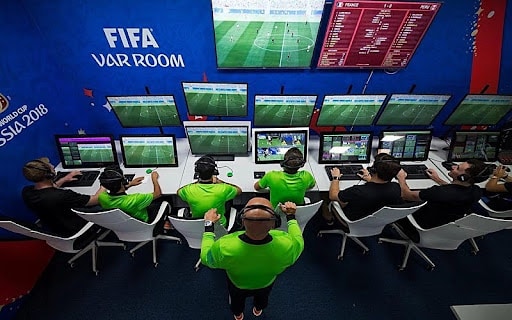
Football once depended heavily on the decisions made by referees on the pitch. However, a single offside situation, controversial goal, or foul inside the penalty area can completely change the outcome of a match. The emergence of VAR Technology has created an important step forward, giving referees an additional tool to review sensitive situations and make more accurate decisions.
What Is VAR Technology?
According to Soco Live TV, VAR technology is a video-based referee assistance system, abbreviated from Video Assistant Referee. The system uses multiple cameras positioned around the stadium to record the match from different angles. A team of VAR officials monitors the footage and can communicate with the referee when they identify a situation that requires review.
VAR does not completely replace the referee on the pitch. The final decision still belongs to the referee. The technology primarily serves to provide additional information in situations that could directly affect the outcome of a match.
For fans following tường thuật trực tiếp bóng đá, moments when the referee stops the match to check VAR often create a particularly tense atmosphere. Just a few minutes of reviewing the footage can determine whether a goal is awarded or disallowed.
How Does VAR Work?
The VAR process begins with the video assistant referee team monitoring the match through the camera system. They continuously observe important situations and communicate with the referee when they identify the possibility of a clear error.
When a situation needs to be reviewed, the VAR team checks the appropriate camera angles. The footage can be replayed at normal speed or in slow motion to accurately assess the moment a player touches the ball, the player’s position, or the severity of contact.
After analyzing the situation, the VAR referee can recommend that the referee review the incident on the monitor located outside the pitch. In some cases, the referee can make a decision based on the information communicated by the VAR team without directly viewing the monitor.
These developments often attract viewers’ attention when watching highlight bóng đá on Socolive, as VAR incidents frequently become the most memorable highlights of a match.
Situations in Which VAR Is Used
VAR is not used arbitrarily for every incident. The system mainly focuses on situations that have a major impact on the match. The four common categories are goals, penalty decisions, direct red cards, and mistaken identity.
For goals, VAR can check whether an offside occurred beforehand, whether the ball went out of play, or whether an attacking player committed a foul. This is one of the situations in which VAR is used most frequently.
In penalty situations, the system can help determine the location of the foul, the severity of the contact, or whether the referee missed an offense that should have been penalized.
For direct red cards, VAR can be used when the referee needs to reassess a dangerous challenge. The system can also help identify the correct player when the referee may have mistaken one player for another.
Fans following tường thuật trực tiếp bóng đá can therefore better understand why a match is temporarily stopped after a controversial incident.
How Has VAR Changed Football?
The introduction of VAR has had a major impact on the way matches are officiated. In the past, an incorrect refereeing decision was almost impossible to change once the match had continued. Today, important incidents can be reviewed based on actual footage.
The biggest advantage is its ability to reduce errors in decisive situations. A goal scored from an offside position or an incorrect penalty decision can have a major impact on the result. VAR gives referees additional evidence on which to base an appropriate decision.
At the same time, the technology has also created a certain level of transparency. When spectators can watch an incident again from multiple camera angles, they can better understand the reasons behind the referee’s decision.
SocoliveTV is also a familiar brand among online football fans, as controversial incidents often become topics of intense discussion after matches.
Limitations of VAR
Despite its many benefits, VAR is not a perfect solution. One of the most frequently mentioned issues is the time required for reviews. When referees need to examine multiple camera angles, a match can be interrupted for several minutes, affecting the flow of the game.
Another limitation involves interpretation. Not every situation has a completely objective answer. Fouls, the intensity of contact, and handball incidents can sometimes still depend on the referee’s judgment.
VAR also makes fans wait longer before celebrating a goal. A goal may initially be awarded on the pitch but then reviewed and subsequently disallowed. This can make the emotions of spectators more complicated.
Platforms such as Soco Live often help fans keep up with match developments and revisit notable incidents after the final whistle.
VAR Technology and the Viewing Experience
VAR affects not only referees and players but also changes the spectator experience. Viewers are increasingly interested in individual frames, player positions, and the exact moment the ball is passed.
Matches featuring goals reviewed by VAR often generate significant discussion within the football community. Fans can offer different perspectives based on the replayed footage.
With Soco Live TV, content related to matches and controversial moments gives viewers additional information to follow football more comprehensively. In particular, football highlights often focus on decisive incidents, allowing viewers to quickly understand the most important developments.
Does VAR Make Football Fairer?
There is no denying that VAR Technology helps reduce certain serious errors. However, technology cannot completely eliminate controversy because the final decision still requires human judgment.
A camera system can accurately determine a player’s position or the exact moment the ball leaves a player’s foot, but situations involving the severity of contact and a player’s intent still require the referee’s assessment.
The important thing is that VAR should be used for its intended purpose and should avoid excessive reviews of incidents that do not have a significant impact on the match. When operated appropriately, VAR can support referees without taking away the natural continuity of football.
Viewers following tường thuật trực tiếp bóng đá should also understand that the time spent reviewing VAR incidents is part of the modern process of officiating a football match.
Conclusion
The introduction of VAR Technology has opened a new era in football officiating. Although limitations and controversies still exist, the video assistance system has significantly reduced the risk of important incidents being missed.
In the future, technology will certainly continue to play an increasingly important role in football. When used properly, VAR does not take away the emotion of the beautiful game; instead, it can contribute to creating a fairer and more transparent playing environment. Fans can continue to keep up with exciting matches, watch football highlights, and follow notable VAR decisions through Socolive.