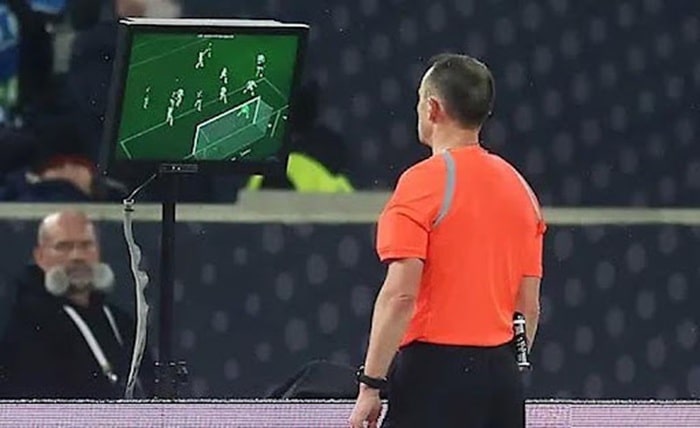
In football, handball incidents are always among the most controversial situations. Not every instance of the ball making contact with the hand or arm is considered an offense. The referee must assess the player’s intention, the position of the hand, body movement, and the impact of the incident before making a decision.
Therefore, understanding the latest handball rules will help fans accurately distinguish between an accidental contact and an incident that may result in a foul.
When Is a Handball Considered an Offense?
Under the current regulations, referees do not simply look at whether the ball touched the hand. An important factor is whether the player deliberately moved their hand or arm toward the ball. If a player actively moves their hand toward the ball to stop it, this is a clear offense.
A second situation occurs when the position of the hand or arm makes the body unnaturally bigger. This is assessed based on the player’s movement in the specific situation. If the position of the hand is not a reasonable consequence of the body’s movement, the referee may determine that a handball has occurred.
For example, a defender running inside the penalty area with both hands in a natural position for balance may not be penalized if the ball unexpectedly hits the hand. Conversely, if a player spreads their arms unusually wide and the ball strikes the arm, the incident may be punished under the rules.
Viewers of Xoilac TV watching top-level football should pay attention to the player’s movement rather than focusing only on the moment the ball makes contact with the hand.
Is a Player Penalized When the Hand Is in a Natural Position?
This is a question that causes many fans to wonder. The answer is that not every ball-to-hand contact results in a foul. IFAB emphasizes that not every instance of the ball touching the hand or arm constitutes a handball offense.
The referee must consider the player’s entire movement. When a player runs, jumps, or turns, the arms may naturally move with the body. If the position is considered a reasonable consequence of the movement, accidental contact with the hand does not necessarily result in a foul.
For example, a player jumping to challenge for the ball may raise their arms to maintain balance. If the ball unexpectedly hits a hand that is in a position consistent with the player’s movement, the referee must assess the context rather than automatically considering it an offense.
This is also why handball incidents often require extensive analysis when reviewed by VAR. Those following the bảng xếp hạng bóng đá Tây Ban Nha on Xoilac TV may also encounter many similar incidents in La Liga matches.
When Does a Handball Result in a Penalty?
If a defending player commits a handball offense inside their own penalty area, the opposing team may be awarded a penalty kick. Under Law 12, handball is one of the offenses that results in a direct free kick; when it occurs inside the defending team’s penalty area, the corresponding restart is a penalty kick.
However, this should not be interpreted to mean that every handball inside the penalty area results in a penalty. The referee must still determine whether the action meets the criteria for a handball offense.
For example, if the ball rebounds from a very short distance onto an arm that is in a natural position, not awarding a penalty may be entirely consistent with the laws. Conversely, a player who deliberately spreads their arm to block the ball may cause their team to concede a penalty.
When watching football online on Xoi Lac TV, fans should pay attention to the referee’s signal and the VAR review process rather than relying solely on the players’ reactions.
What Are the Notable Changes in the Latest Handball Rules?
The IFAB 2026/27 edition of the Laws of the Game has been published and applies from the new season. However, the changes announced for Law 12 in this edition focus on other issues, such as DOGSO and disciplinary matters, rather than introducing an entirely new principle for determining handball.
This means that the core interpretation of handball still revolves around deliberately using the hand and whether the position of the hand makes the body unnaturally bigger. This is an important point for fans to remember when encountering information described as the latest handball rules.
IFAB also specifies that the upper boundary of the arm is defined as level with the bottom of the armpit. Therefore, the part of the body above this boundary is not treated as the hand or arm in handball situations.
Does a Ball That Deflects Off the Body and Then Hits the Hand Count as a Foul?
A commonly disputed situation occurs when the ball rebounds off a player’s leg, body, or head before subsequently hitting the hand. In this case, the referee must still assess the position of the hand and how the player performed the movement.
There is no simple rule stating that if the ball deflects off another part of the body before hitting the hand, it is automatically not a foul. Conversely, there is also no rule stating that a ball touching the hand after a deflection must automatically be penalized.
What matters is whether the hand was in a reasonable position and whether the player deliberately created an obstruction with the hand. Therefore, even a situation involving a very short distance must be assessed according to the specific circumstances.
Viewers following Xôi Lạc Z may notice that referees often have to review multiple camera angles in these situations before making an accurate decision.
A ball deflecting off the body before touching the hand is an incident that must be assessed based on the hand’s position and the specific circumstances
How Is a Defender Penalized for Deliberately Using the Hand to Stop the Ball?
If a defender deliberately uses their hand to stop the ball, this is a clear offense. The disciplinary action depends on the location and consequences of the incident.
If the offense occurs outside the penalty area, the opposing team will generally be awarded a direct free kick. If it occurs inside the defending team’s penalty area, the opponents may be awarded a penalty.
In terms of individual disciplinary action, the card depends on the nature of the offense and whether the player prevented a goal or an obvious goal-scoring opportunity. Law 12 also provides that deliberately using the hand to prevent a goal or an obvious goal-scoring opportunity may result in a red card under specific conditions.
Viewers of Xôi Lạc Tivi should not only pay attention to whether the team receives a penalty but also consider whether the offending player may receive a card.
How Does VAR Help Determine Handball Offenses?
VAR plays an important role in handball incidents involving goals or penalty decisions. Under the 2026/27 VAR protocol, situations that may be reviewed include attacking handball offenses during the buildup to a goal, as well as penalty situations that are awarded or not awarded.
However, VAR does not completely replace the on-field referee. The technology primarily assists when there is a possibility of a clear and obvious error in situations that fall within the permitted review scope.
This helps reduce incorrect decisions in important matches, particularly when a handball incident can directly affect the outcome.
La Liga matches also frequently feature situations requiring VAR, so those interested in the bảng xếp hạng bóng đá Tây Ban Nha can also pay attention to decisions involving penalties and handball.
How Is Handball by a Goalkeeper Different?
Goalkeepers are allowed to use their hands inside their own penalty area. Therefore, the handball rules cannot be applied to them in exactly the same way as they are to outfield players.
Under Law 12, the handball offense applies to players, except for the goalkeeper within their own penalty area. However, goalkeepers are still restricted from using their hands when outside this area.
If a goalkeeper leaves the penalty area and uses their hand to touch the ball, the action may be treated in the same way as it would be for an outfield player. The punishment depends on the location and nature of the incident.
This is a detail that can easily confuse people who are new to football rules. When following information on XoilacTV, viewers can pay attention to the goalkeeper’s position before evaluating a handball incident.
Common Misunderstandings About Handball Rules
One of the most common misconceptions is the belief that “if the ball touches the hand, it is definitely a foul.” In reality, IFAB clearly confirms that not every contact between the ball and the hand or arm constitutes a handball.
Another misconception is that a player will be penalized whenever their hand is not close to their body. This is also not entirely accurate. The referee must determine whether the hand’s position is a reasonable consequence of the player’s movement or whether it makes the body unnaturally bigger.
In addition, many people believe that if a player did not intend to handle the ball, they cannot commit an offense. This is also an incomplete interpretation because intent is not required in every situation. A hand positioned in a way that makes the body unnaturally bigger can also constitute handball under the current laws. When watching Xoilac Live, fans should consider the entire sequence rather than focusing only on the moment the ball touches the hand.
How Do Handball Rules Affect a Match?
Decisions involving handball can directly affect the course of a match. A penalty can change the score, while a goal disallowed because of an attacking handball during the buildup can have a major impact on the final result.
Therefore, referees must carefully consider the situation before making a decision. VAR provides assistance in incidents that fall within its review scope, but applying the laws still requires professional judgment and consideration of the actual context.
For fans who regularly follow the bảng xếp hạng bóng đá Tây Ban Nha, understanding the handball laws will give them a more accurate perspective when analyzing matches involving controversial penalty or goal decisions.
Conclusion
Understanding the latest handball rules helps fans see why the referee may make different decisions in situations involving similar handball incidents. The key factors are whether the player deliberately used the hand, whether the position of the hand made the body unnaturally bigger, and the circumstances in which the incident occurred.
Once these principles are understood correctly, viewers of Xôi Lạc Link can more easily distinguish between accidental contact, a legal situation, and a handball offense that may result in a free kick or penalty. This is also important knowledge for following football in a more objective and accurate way.